2001: A Space Odyssey review and summary 🌌
(WARNING: This review contains spoilers about the movie. In fact, I describe its progression almost entirely).
I consider this movie a masterpiece. I'm not very fond of the sci-fi genre, but this movie cuts across its tags, delving into my mind as no other film has ever done before. In order not to leave certain aspects of the film uncovered, I have divided the review in: my opinion, technical aspects, and description of the film itself.
My opinion (forgive the possible scientific mistakes I may commit): 2001: a space odyssey has made me think in ways I never thought I ever could. Of course, it is very thought-provoking. It graced me with endless thoughts about the future of mankind, about the existence or non-existence of a God, about the development of artificial intelligence, and so on and so forth... But the main concern it placed on me is about the universe and its limits. Does the universe have limits? Are we just too naive, or does the concept of the immeasurable exist too?
Besides the never ending waves of thoughts I could helplessly write down here, 2001 is a movie of beauty and exploration. It is a movie about (maybe) the whole truth of the universe (if there is one). The futuristic approach of it is almost perfect; one cannot find scientific mistakes; it is the movie to beat in terms of sci-fi.
It also shows similar behavior and nature, displayed on completely different types of beings: such as humans and computers. The fear of death is a great feeling, which is conveyed from mankind to computers flawlessly.
Technical aspects
Direction
Director Stanley Kubrick makes a wonderful job at setting the pace of the film. It is as slow as it could be, yet it couldn't have been better. What would you expect from a space movie? It has to show beauty and vastness. There are a lot of interesting cuts, such as: the ellipsis between the bone and the satellite, the fast cuts prior to Poole's assassination, the slit scan used in the stargate sequence. The overall atmosphere is astonishing; it demands a second view to spot more details on some scenes.
Plot
It is very nice to see a movie forcing you to actually THINK. The plot is clearly portrayed, yet it is not served to you in a plate. This also leads to different theories about some parts of the film (mainly the ending), which makes the movie even more complex and rewarding.
Visual effects
They are amazing. The use of practical visual effects here is more than remarkable, and sets the bar quite high for other contemporary movies. Heck, it even stands still upon some new-blockbuster movies (which also lack a lot of 2001's charm and story). The huge sets for each scene are more than convincing. The docking station set, for instance, cost about 750 grand at the time. In the description of the movie I've mentioned some of them (i.e. the pen).
Soundtrack
Also sprach zarathustra by Strauss is a wonderful vehicle, either to bring a sense of awesomeness in the movie, and to drop a hint about Nietzsche's ideas being used later for the film. Atmospheres by Ligeti is my favorite track on the movie. Other great compositions include The Blue Danube by Strauss.
Acting
Kubrick's movie may seem cold on many levels. But for me, the coldness of the characters is a matter of professionalism shown in the film. I highly dislike seeing amateur-ish attitudes on people who are trained for extreme conditioning (read: Bullock on Gravity).
#DESCRIPTION OF THE MOVIE 2001 opens with a pitch black screen, which lasts for about three minutes. While we stare at deep blackness, sounds and noises of unknown nature are heard. I was a little bit creeped the first time I saw it, and was expecting a screamer at the end of the segment (little did I know). However it filled with a sense of vastness, and set the tone for the rest of the scenes.
Next, we are graced with a more familiar opening, which consists of the sun "rising above" planet Earth, with the Moon behind them (camera's pov). The tone poem used for this scene is "Also sprach zarathustra", composed by Richard Strauss (which is not a haphazard choice). This intro is majestic and shows a little of what's coming in terms of visual effects.
The director's name and movie title are displayed at this point.
We are now presented with the first chapter of the movie, titled "The dawn of man". Beautiful, still landscapes are shown until we encounter the first characters in the film: apes.
This group of apes we see share their territory with tapirs. Tapirs come from Southeast Asia; so, taking a wild guess, the film's first chapter is set there. A tiger attacks an ape from above, resulting in its death. The rest of the apes run amok. Next thing we see is another group of monkeys, who want to conquer the pond the other group is drinking water from. The two groups proceed to scream wildly -in order to intimidate each other- and the group who wanted to take over the pond leaves.
Once the scene ends, a tiger is seen among the corpse of a zebra. Director Stanley Kubrick clearly wants to make a point about "the survival of the fittest" here.
At nightfall we see the apes, crowded behind some rocks, with a scared look on their faces.
The next day, when the first ape wakes up, it fiercely wakes up the rest. Here, they go crazy for the second time, but now because of the sight of the black monolith. They are bewildered by the strange presence. After admiring the monolith, the apes begin to touch the tall slab. The monolith's top part gets aligned with the sun. This scene is thought-provoking and confusing. It also marks the first appearance of the mighty monolith.
Later, an ape is looking at a skeleton and awkwardly grabs a bone. The primitive being uses the bone to smash the rest of the bones in a violent hitting motion. This event is a very direct approach to evolution. The apes had discovered the sense of tools and weapons.
The monkeys are now eating meat -it means they are conquering the food chain- i.e. tapirs.
Another day passes (maybe more time) and a second fight for the pond arises. This time, though, a group of apes has bones in their hands, which they use as weapons. One monkey gets savagely beat up. In the midst of primitive madness, a monkey tosses a bone up in the air. The camera pans to the bone raising and falling. Director Stanley Kubrick makes a fast cut to a bone-shaped artificial satellite in space: 8 million years of evolution placed on a VERY powerful ellipsis, which lasts roughly ten seconds.
At this point the movie shows the beauty present in space, with "The Blue Danube" waltz as background music. The practical visual effects here are remarkable and awe-inspiring for a movie released in 1968.
After some lengthy takes, we get to see a huge rotating docking station, which looks as realistic as it gets.
We see the interior of a Pan-Am commercial spaceship. At this point, one of the human main characters appears. At the back of each seat there is a FLAT screen showing movie footage. In the hallway there is a pen floating in mid air, so an air stewardess proceeds to fight through zero gravity (with her grip shoes) in order to retrieve the wayward flying pen (another IMPRESSIVE practical effect, which only consisted of a pen taped to a sheet of glass).
The spaceship proceeds to dock at the docking station ever so slowly.
Upon docking, the first main character, (at least in terms of appearance on the big screen) whose name is Dr. Heywood Floyd, uses a voiceprint identification system (which is supported by a rather flat TV screen) in order to proceed to the space station.
As a side note, I'd like to recall the noticeable amount of product placement on details. I think this idea was a huge gamble at the time, since companies like Pan-Am are no longer operating.
Dr. Floyd proceeds to a telephone cabin, in order to place a videocall. This is beyond innovating, since videocalling technology wasn't really available until the late 80's, and wasn't cheap either (here the call cost 1,70$). I'd like to mention a line in the conversation between Dr. Heywood Floyd and his daughter (played by Vivian Kubrick!): the daughter wants a telephone for her upcoming birthday, and Floyd grinningly says "We've got lots of telephones already!". Quite accurate.
After finishing the call, Dr. Floyd meets a bunch of soviet doctors. This scene, maybe, tried to tell us how the space race may have never ended. One of the soviet people inquiries Heywood about a US space base not receiving calls and not allowing foreign spaceships to dock. That was the base the american professional was heading to.
Finally, Heywood Floyd heads for his flight to the moon. Here there are some scenes depicting space travel, with some neat zero gravity details like walking, or food trays reacting accordingly to it. Kubrick shows landing as an extremely graceful and slow process.
Next up Floyd gives a brief speech about the absolute necessity of hermetic silence when it comes to the activities surrounding the US base, for revealing them would cause a great social shock.
Now with a creepier classical piece, Dr. Heywood Floyd heads to the strange artifact deliberately buried on the moon, in order to elaborate some reports.
Once they arrive, they head to the unknown object. With a great share of suspense, the astronauts decide to get near the monolith. As they are taking pictures of it, Floyd touches the perfectly flat black surface. When the group of astronauts get together to take a picture, a strange high-pitched noise begins to sound. Once again, the top of the monolith aligns with the Sun.
Now begins chapter 2: Jupiter Mission (18 months later).
A fairly large spaceship is seen gliding across space. One of the characters is seen jogging inside it. One compartment of the spaceship, which holds 3 hibernating astronauts, has an odd spherical shape. The two active human characters on the spacecraft are able to see a BBC broadcast through a device that uncannily resembles today's tablet PC's. The broadcast consists of an interview to the astronauts and to the sixth member of the crew: computer HAL 9000. I don't want to highlight the entire interview (although I would eagerly do so), but here's two key quotes about it: HAL: I am putting myself to the fullest possible use, which is all I think that any conscious entity can ever hope to do. HAL: The 9000 series is the most reliable computer ever made. No 9000 computer has ever made a mistake (...). We are all (...) foolproof and incapable of error.
After the interview and some misc scenes (albeit important, i.e. the chess scene with an intentional mistake by HAL), Hal decides to ask Bowman whether he was having second thoughts about the mission. He then proceeds to warn Dave about a fault in the AE-35 unit.
Dave Bowman proceeds to repair the faulty unit in a beautifully crafted space scene. The way in which Dave is exposed to the void and vastness of space is incredibly demonstrated.
Back at the spacecraft, Poole and Bowman decide to examine the apparently faulty unit. They find out that the unit is in perfect state, and thus, that Hal has made a mistake.
Bowman quickly realizes something is wrong and tries to talk with his deputy Frank Poole. They finally talk inside a pod, where Hal wouldn't hear them. But little did they know, Hal could read their lips.
Later, Poole goes outside of the spaceship to place the non-faulty unit back. Three brilliant fast cuts of Hal's red eye, and Poole is floating aimlessly in space, his oxygen tank wire cut. Bowman attempts to rescue Poole, and gets his corpse eventually. In the meanwhile, Hal kills the hibernated men on purpose.
Bowman affords to get back to Discovery's pod bay. Except he has to command Hal to open the pod bay doors. Here, Hal is totally sincere and tells Dave about his own flaws and fears of being killed. The evil computer denies permission for Bowman to enter, and so he has to now find another way in (through the emergency airlock). In a heroic, yet scientifically accurate way, Dave gets to enter Discovery through the airlock without his helmet.
Mad as a cow, Dave proceeds to literally disconnect (kill) Hal. This scene is pivotal in the movie, and gets to show the emotional bond between a human and a programmed entity (as Dave asks Hal to sing Daisy Daisy).
Hal feels his "mind" going; he has certain fear of the unknown. He is afraid and wants to live, just as any other human being. David feels panicked as he is now officially the most lonely person on the universe. He may also feel discomfort from the idea of murdering someone.
Suddenly, as Dave enters Jupiter's space, a prerecorded briefing is played. It explains the authentic purpose of the entire mission.
Chapter 3: Jupiter and Beyond (pretty much sums it up). Dave reaches out for the monolith in a pod, and watches it align with other planets. He is speechless... as he enters into a sort of stargate, or trip toward his transcendence on time and space perhaps.
The rest is all beautiful (unknown) imagery along with a seamless score. I found this part very powerful, for it sheds light into the -for now- hidden parts of the visible universe. There is one take which really impressed me, and never ceases to do so even on my fifth viewing of the film. The sense of redemption and clarity it brought on me was unparalleled. It contains this image:
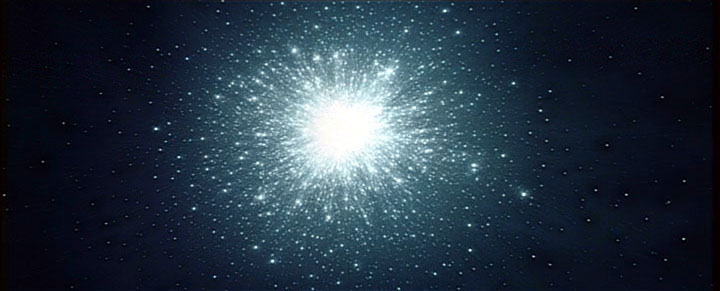
After taking a glance at the universe itself, the pod begins to descend into some strange world, maybe inhabited. Toward the end we see Bowman age and decay (in an orchestrated way), thus evolving into a new being.
This new being is, apparently, of epic proportions, and has seen it all.
END OF MOVIE DESCRIPTION.
Thanks for reading!