Parallel programming in the JVM
Introduction to parallel computing
Parallel computing is a type of computation in which many calculations are performed at the same time. A computation can be divided into smaller subproblems, which can be solved simultaneously
To do this we have parallel hardware (multicore processors), which are capable of executing tasks in parallel
History
- Analytical engine (Babbage)
- Parallel analytical engine (Luigi Menabrea)
- IBM built comercial parallel computers - user CPUs relied on increasing clock speeds
- CPU frequency scaling hit the power wall, we now need multiple CPU cores
Parallel programming is much harder than sequential programming
- Separating computations is challenging and not always possible
- Correctness is more difficult. New types of errors
- Performance is the only benefit
Parallelism vs. concurrency
Parallel programs use parallel hardware to execute computations more quickly
- More efficiency
- Algorithms, hard computations, big data, simulations
Concurrent programs may or may not execute multiple executions at the same time
- More modularity, responsiveness, maintainability
- Async apps, responsive UIs, databases
Parallelism granularity
- Hardware supported
- Bit-level: increase in CPU word length from 4 to 32 bits means more instructions in fewer instructions
- Instruction-level: 32 to 64-bit architecture, vector instructions. Different instructions from same instruction stream
- Software supported
- Task-level: separate instruction streams in parallel -> aim of this course
Classes of parallel hardware
- Multicore processors: contains multiple processing units (cores) on the same chip
- SMP (symmetric multicore processors): multiple processors which share memory and are connected by a bus
- GPGPU: coprocessor for graphics processing. executes instructions requested by the CPU
- Field-programmable gate arrays: can be reprogrammed according to the task, improves performance optimizing for a particular app
- Computer clusters: group of computers connected by a network, not sharing memory
Parallelism on the JVM
Basic definitions
Operating system: manages hardware and software resources, schedules program execution
Process: instance of a program executing in the OS with a PID. 1 program -> n instances. Each process owns a separate slice of memory
Multitasking: multiplexing different processes and CPUs to get time slices of execution
Atomic: an operation is atomic if it appears as if it occured instantaneously from the POV of other threads
Thread: independent concurrency units inside a process. Started from within the same program, they share a memory space (heap). Has a program counter (PC) and its own private stack
JVM threads communicate through their shared heap, as their stacks are private
Main thread: used to start additional threads via a Thread object and a start() method
class MyThread extends Thread {
  override def run() {
    println("Hello from a thread!")
    println("Hiii!")
  }
}

val t = new MyThread
val u = new MyThread
t.start()
u.start() // two threads have started, print statements "race"
t.join() // blocks main execution, waits for thread completion
u.join()
Two statements in two threads can overlap randomly
Synchronized
To enforce atomicity, the synchronization primitive synchronized ensures, using a monitor, that a block of code is never executed by two threads at the same time
private val x = new AnyRef {}
private var uidCount = 0L
def getUniqueId(): Long = x.synchronized {
  uidCount = uidCount + 1
  uidCount
}
Nested synchronized blocks:
class Account(private var amount: Int = 0) {
  def transfer(target: Account, n: Int) =
    this.synchronized {
      target.synchronized {
      this.amount -= n
      target.amount += n
    }
  }
}
A thread running the transfer method first obtains a monitor on the source this and then obtains a monitor on target. Once it obtains both monitors, it performs the call
Using synchronized poses a major problem: deadlocks. The shared resource is monitor ownership, and both threads hold and wait
...
val t = startThread(a1, a2, 150000)
val s = startThread(a2, a1, 150000) // DEADLOCK
t.join()
s.join()
Resolving deadlocks
- Always acquire resources in the same order => ordering relationship on the resource (unique id per account)
Memory model
How do threads share memory?
- Two threads writing to separate locations in memory do not need synchronization
- A thread X that calls
y.joinon another thread Y is guaranteed to observe all writes by Y to memory aftery.joinreturns
Parallel computations
Motivating example
Compute the p-norm of a vector (when p = 2, the 2-norm is the length of a vector on the XY axis)
Sequential solutions:
def sumSegment(a: Array[Int], p: Double, s: Int, t: Int): Int = a.slice(s, t).map(n => n ** p).sum() ** 1/p // my implementation

def functionalSumSegment(a: Array[Int], p: Double) = reduce(map(a, power(abs(_), p)), _ + _)

// sequential implementation:
def sumSegment(a: Array[Int], p: Double, s: Int, t: Int): Int = {
  var i = s; var sum: Int = 0
  while (i < t) {
    sum += power(a(i), p)
    i++
  }
  sum
}
Parallel solution: observe that we can divide the sum in two, and the sum of the two partial sums equals the whole sum. Is there a recursive algorithm for an unbounded number of threads and array divisions?
Let's use recursion:
def pNormRec(a: Array[Int], p: Double): Int = power(segmentRec(a, p, 0, a.length), 1/p) // calculator, helper function

// parallel sumSegment:
def segmentRec(a: Array[Int], p: Double, s: Int, t: Int) = {
  if (t - s < threshold)
    sumSegment(a, p, s, t) // small segment is sequential
  else {
    val m = s + (t - s)/2 // take half
    // now compute halves in parallel, potentially with more recursive parallel computations inside
    val (sum1, sum2) = parallel(segmentRec(a, p, s, m), segmentRec(a, p, m, t))
    sum1 + sum2
  }
}
Signature and implementation of parallel
def parallel[A, B](taskA: => A, taskB: => B): (A, B) = { ... }
- Returns the same value as given
parallel(a, b)faster then(a, b)- Takes arguments by name (lazy) -> we need to pass unevaluated computations
Parallel uses JVM threads, which map to OS threads. The OS can schedule different threads on multiple cores
If we have sufficient resources, a parallel program can run faster
Underlying hardware affects performance
Consider a program, same as above, which sums up array elements instead of their powers
This computation is bound by memory bandwidth (i.e. how many elements of the array can be held in memory)
Both the sequential and parallel version end up accessing the array through the same memory, generating a bottleneck which neglects parallel performance benefits
Monte Carlo method: estimate π
Consider a square and a concentric circle of radius 1 (inside the square)
The ratio (division) between the 1/4 of the surfaces of the circle (π) and the square (2^2) is π/4, let's call this lambda λ
To estimate λ, randomly sample points inside the square and count how many fall inside the corresponding piece of circle. To get π, just do λ*4
import scala.util.Random

def mcCount(iter: Int): Int = {
  val randomX = new Random
  val randomY = new Random
  var hits = 0
  for (i <- 0 until iter) {
    val x = randomX.nextDouble // [0, 1]
    val y = randomY.nextDouble // [0, 1]
    if (x*x + y*y < 1) hits = hits + 1 // if inside circle, count
  }
  hits
}
def monteCarloPiSeq(iter: Int) = 4.0 * mcCount(iter) / iter
Parallel version:
def monteCarloPiPar(iter: Int): Double = {
  val ((pi1, pi2), (pi3, pi4)) = parallel(
    parallel(mcCount(iter/4), mcCount(iter/4)),
    parallel(mcCount(iter/4), mcCount(iter/4))
  )
  4.0 + (pi1 + pi2 + pi3 + pi4) / iter
}
First-class Tasks
Recall
val (v1, v2) = parallel(v1, v2) // v1 and v2 computed in parallel, returning results
Using a new construct, task, we can describe the same computation:
def task(c: => A): Task[A]

trait Task[A] {
  def join: A
}

val t1 = task(e1) // starts computation in background
val t2 = task(e2)
val v1 = t1.join // blocking main thread
val v2 = t2.join

def parallel[A, B](cA: => A, cB: => B): (A, B) = {
  val tA = task(cA) // new task
  val tB = cB // evaluating
  (tA.join, tB)
}

// 4 task version:
def parallel[A, B, C, D](taskA: => A, taskB: => B, taskC: => C, taskD: => D): (A, B, C, D) =
  val ta = task { taskA }
  val tb = task { taskB }
  val tc = task { taskC }
  val td = taskD
  (ta.join(), tb.join(), tc.join(), td)
Always remember to avoid unnecessary blocking, which leads to sequential computing
Performance of parallel programs
- Empirical measurement (running the program)
- Asymptotic analysis (worst-case, big O)
- Analyze input volume
- Analyze hardware
Asymptotic analysis, sequential and unbounded
- Work W(e): the number of steps
ewould take if there was no parallelism, takinge1 + e2as running time forparallel(e1, e2)- W(parallel(e1, e2)) = W(e1) + W(e2) + C
- Depth D(e): number of steps if we had unbounded paralellism, taking
max(e1, e2)as running time forparallel(e1, e2)- D(parallel(e1, e2)) = max(D(e1), D(e2)) + C
For sequential parts of our code, we must add up the work cost W. For parallel parts, the depth cost D counts only once (the larger branch)!
sumSegment has a O(t - s) time bound, because we sum a t - s slice of the array
The sequential version has a performance of O(n), while the parallel version has a recursive call tree of depth N and resolves to a time bound of O(log(t - s))
Time bound for P given parallelism
Suppose we know W and D, and our hardware has P parallel threads
Estimate for running time: D + W/P
- If P -> ∞ (best case), notice running time is the depth D, which means infinite parallelism
- If P is constant and inputs grow, parallel programs have same complexity as sequential ones
Amdahl's law
Two parts of a sequential computation (part2 depends on part1):
- part1 takes fraction f of the time
- part2 takes the remaining 1 - f fraction, and we can speed it up
If we make part2 P times faster, the speedup is
1 / (f + (1 - f) / P)
This function has diminishing returns (plateau) for big values of P
Benchmarking
Performance factors:
- Processor speed
- Number of processors
- Memory latency and throughput (+ bus overhead)
- Cache behavior (false sharing, associativity, levels)
- Runtime behavior (garbage collection, JIT compilation, thread scheduling)
Read: What Every Programmer Should Know About Memory
Measurement methodologies
- Multiple repetitions
- Mean and variance, confidence intervals and outliers
- Steady state (JVM warm-up)
- Prevent anormalities (GC memory, JIT compilation, optimizations)
Read: Statistically Rigorous Java Performance Evaluation
ScalaMeter
Benchmarking (current performance) and performance regression (compare against previous runs) testing for the JVM
val time = config(
  Key.exec.minWarmupRuns -> 20,
  Key.exec.maxWarmupRuns -> 60,
  Key.verbose -> true
) withWarmer(new Warmer.Default) measure { // warmer: warm the JVM before testing
  (0 until 1000000).toArray
}
Measurers: Default, IgnoringGC, OutlierElimination, MemoryFootprint, GarbageCollectionCycles, boxing counts
Parallel sorting
Recursively sort two halves of the array in parallel. Then, sequentially merge the halves
def parMergeSort(xs: Array[Int], maxDepth: Int): Unit = {

}

def sort(from: Int, until: Int, depth: Int): Unit = {
  if (depth == maxDepth) quickSort(xs, from, until - from)
  else {
    val mid = (from + until) / 2
    parallel(sort(mid, until, depth + 1), sort(from, mid, depth + 1))
    // now merge the arrays:
    val flip = (maxDepth - depth) % 2 == 0
    val (src, dst) = if (flip) (ys, xs) else (xs, ys)
    merge(src, dst, from, mid, until)
  }
}
Folding trees
Lists are not good for parallel implementations (hard to split, hard to combine. O(n) time)
Alternatives: Array, Tree
def reduce[A](t: Tree[A], f: (A, A) => A): A = t match {
  case Leaf(v) => v
  case Node(l, r) => f(reduce[A](l,f), reduce[A](r, f))
  // simple parallel optimization for Nodes:
  case Node(l, r) => {
    val (lV, rV) = parallel(reduce[A](l, f), reduce[A](r, f))
    f(lV, rV)
  }
}
The computational complexity of parallel reduce over a tree is O(n) and is equal to the height of the three, since we take the max of the two halves every time we compute a node (result: the max looks like a list)
For correctness of reduce, the operation f must be associative
In general, it is best to work with associative and commutative operations
Compute average of a list using a single reduce
val f = ((sum1, len1), (sum2, len2)) = (sum1 + sum2, len1 + len2)
val (sum, length) = reduce(map(someList, (x: Int) => (x, 1)), f)
sum / length
Parallel scan (prefix sum)
The scan method is similar to fold, but it returns all the intermediate results of the algorithm. List(1, 3, 8).scanLeft(100)(add) == List(100, 101, 104, 112)
def scanLeft[A](input: Array[A], a0: A, f: (A, A) => A, out: Array[A]): Unit = {
  out(0) = a0
  var a = a0
  var i = 0
  while (i < input.length) {
    a = f(a, input(i))
    i += 1
    out(i) = a
  }
}
This sequential implementation is linear. Let's make a parallel implementation which runs in O(log n). This is difficult because each element in the sequence depends on all previous ones
We need to stop depending on the intermediate results, so we will do extra computations in exchange for parallelism
Data Parallelism
In contrast to task parallelism, data parallelism distributes data across computing nodes
Mandelbrot set (for loop)
How can we render the Mandelbrot set using CPU cores effectively?
def parRender(): Unit = {
  for (idx <- (0 until image.length).par {
    val (xc, yc) = coordinatesFor(idx)
    image(idx) = computePixel(xc, yc, maxIterations)
  }
}
This effectful for loop is parallel. For each pixel, the workload varies
Parallel collections
(1 until 1000).par
  .filter(n => n % 3 == 0)
  .count(n => n.toString == n.toString.reverse)
Count palindromes in a parallel fashion
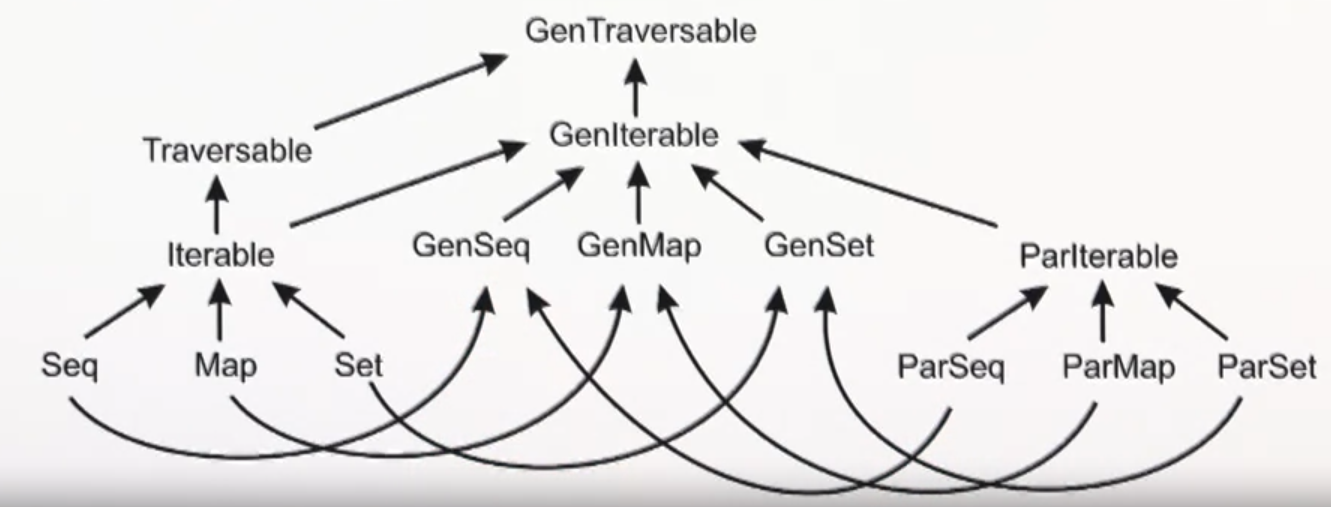
Scala collections hierarchy
Traversable[T]- collection of elements with operations implemented usingforeachIterable[T]- subtype ofTraversable, operations implemented usingiteratorSeq[T]- ordered sequenceSet[T]- set of non duplicatesMap[K, V]- map of keys and values
Their parallel counterparts are ParIterable, ParSeq, ParSet, and ParMap
For code agnostic about parallelism, there is a separate hierarchy of generic collection traits: GenIterable, GenSeq, GenSet, GenMap. Generic collections can be used as parameters in functions, where we can then pass either a sequential or parallel collections
The Iterator
trait Iterator[A] {
  def next(): A
  def hasNext: Boolean
  def foldLeft[S](z: S)(f: (S, T) => S): S = {
    var result = z
    while (hasNext) result = f(result, next())
    result
  }

}
The Splitter
A Splitter is a special case of an Iterator and helps to partition a collection into multiple disjoint subsets. The idea is that after the splitting, these subsets can be processed in parallel. You can obtain a Splitter from a parallel collection by invoking .splitter on it
To split a Splitter, simply use .split, which returns Seq[Splitter[A]], the sequence of new splitters, each containing a subset of the collection. Each Splitter has an attribute remaining: the number of elements of the current collection. remaining can be used as a threshold value (to split or stop splitting)
The Builder
Builders are used internally to create new (sequential) collections. Here is an example of filter using a Builder. Repr == Seq[T]
trait Builder[A, Repr] {
  def +=(elem: A): Builder[A, Repr]
  def result: Repr
}

def newBuilder: Builder[A, Repr]

def filter(predicate: T => Boolean): Repr = {
  val b = newBuilder
  for (x <- this) if (predicate(x)) b += x
  b.result
}
The Combiner
A Combiner is a parallel version of a Builder, and a counterpart to a Splitter
trait Combiner[T, Repr] extends Builder [T, Repr] {
  def combine(that: Combiner[T, Repr]): Combiner[T, Repr]
}
Converting (parallelizing) collections
Arrays, Ranges, Vectors, HashSets, HashMaps and TrieMaps can be converted to parallel by using the par method
List is converted to a parallel vector. Pick parallelizable data structures such as Vector in favour of non parallelizable, such as List
Thread safe collections
ConcurrentSkipListSet and ConcurrentSkipListMap are useful when you need a sorted container that will be accessed by multiple threads. These are essentially the equivalents of TreeMap and TreeSet for concurrent code (source: StackOverflow)
- Never write to a collection that is concurrently traversed
- Neved read from a collection that is concurrently modified
TrieMap collection and snapshot
The TrieMap is an exception to the above rules. The snapshot method can be used to efficiently grab (clone) its current state, avoid concurrent modifications of a traversed collection
Parallel fold?
Although we can't use reduce or foldLeft in parallel, it is possible to use fold in parallel. fold has a nicer type signature with a neutral element, which allows for data parallelism when using associative functions, where the neutral element and the functions share a common type:
xs.par.fold(0)(_ + ) // parallel sum a xs
xs.par.fold(Int.MinValue)(math.max)
To ensure fold works correctly under parallel cases, the neutral element and the binary operator must form a monoid
Aggregate
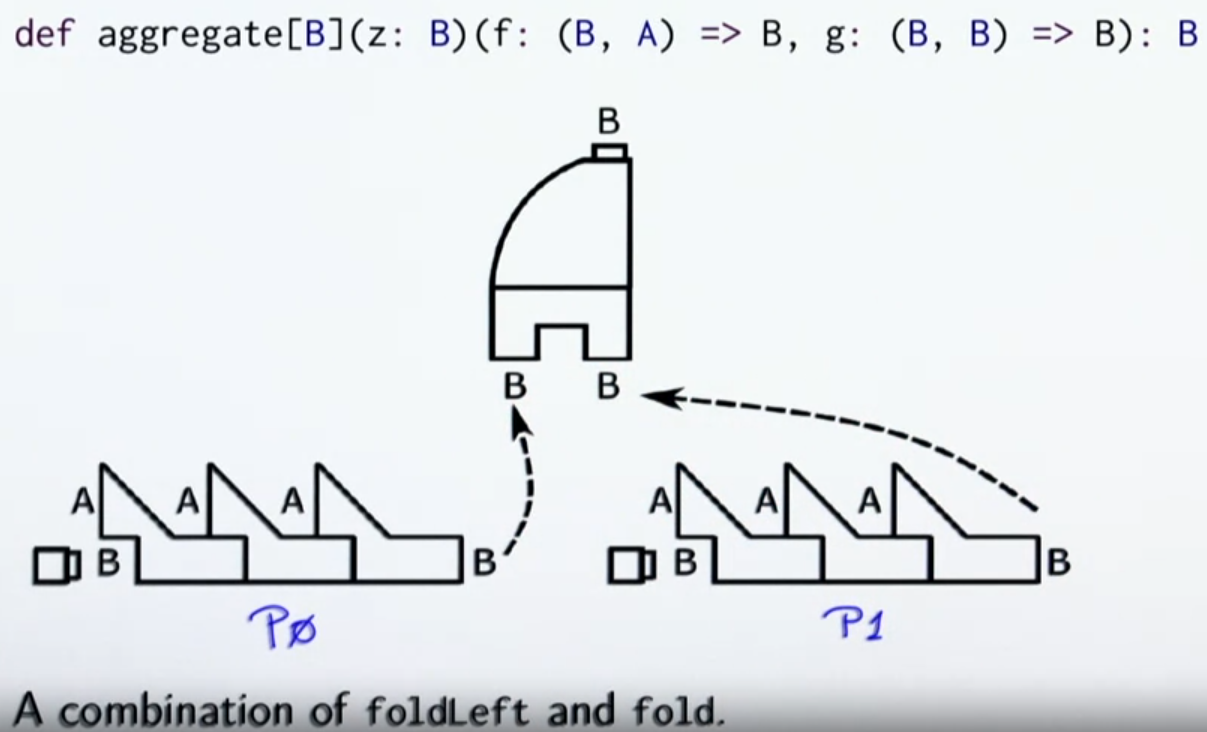
// count vowels
Array('E', 'P', 'F', 'L').par.aggregate(0)(
  (count, c) => if (isVowel(c)) count + 1 else count, // folding operator
  _ + _  // grouping operator
)
Implementing Combiners
Combine means union or concatenation depending on the data structure. The combine method must be efficient, executing in O(log n + log m) time, where n and m are the sizes of two input combiners
Arrays CANNOT be efficiently concatenated. Most set implementations do not have efficient union
Parallel two-phase construction
When using combiners, the intermediate data structures are of the same type that the final data structure
In two-phase construction, the intermediate data structure is a different one, having an efficient combine method, and an efficient += method
The two phases are:
- Combine the intermediate data structures until there is only one of them
- Transform the only data structure left to the desired type
Efficient two-phase construction of arrays is based on nested array buffers and pointer (reference) copying
Efficient two-phase construction of hash tables is based on buckets containing a linked list of arrays, non-overlapping based on a hashcode
Efficient two-phase construction of search trees is based on total ordering and non-overlapping intervals
Conc-tree data structure
Trees are only good for parallelism if they are balanced. For that, we have a data type called Conc, which represents balanced trees
sealed trait Conc[+T] {
  def level: Int
  def size: Int
  def left: Conc[T]
  def right: Conc[T]
}

case object Empty extends Conc[Nothing] {
  def level = 0
  def size = 0
}

class Single[T](val x: T) extends Conc[T] {
  def level = 0
  def size = 1
}

case class <>[T](left: Conc[T], right: Conc[T]) extends Conc[T] {
  val level = 1 + math.max(left.level, right.level)
  val size = left.size + right.size
}
The level difference between the left and right subtree of a <> must be 1 or less
Amortized, constant-time append operation
def +=(elem: T) {
  xs = xs <> Single(elem)
}

case class Append[T](left: Conc[T], right: Conc[T]) extends Conc[T] ...
Append trees has O(1) append and O(log n) concatenation