Pettable's $14.99 Monthly Trap: Customers Never Agreed to This
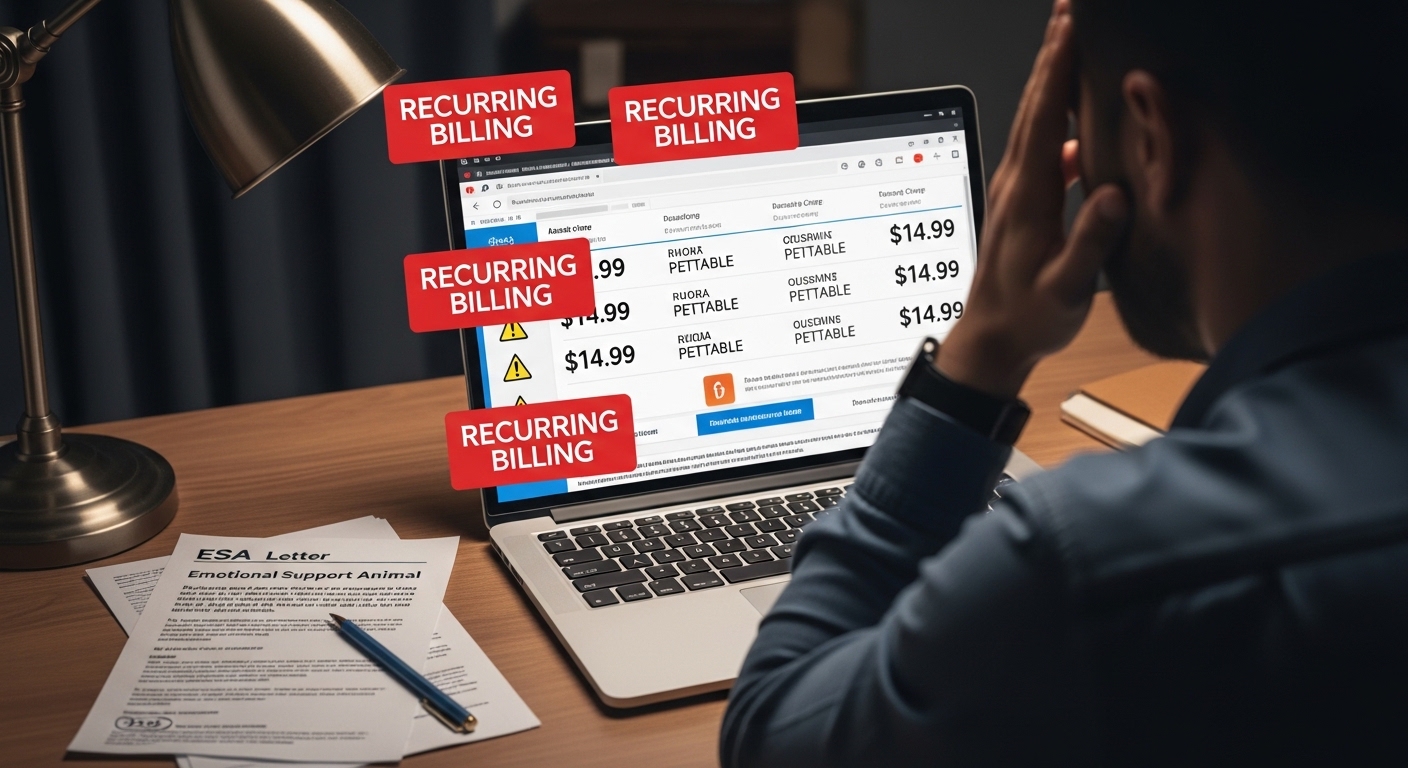
This is not an isolated billing error. It is a documented, recurring complaint pattern that spans BBB filings, Medium exposés, independent review platforms, and consumer protection complaint boards. Pettable has built a subscription product marketed as the "ESA Letter Value Bundle" or similar into its checkout flow in a way that a significant number of customers describe as never having knowingly agreed to. The subscription charges $14.99 per month, continues until actively cancelled, and is structured in the checkout process in a way that customers consistently describe as non-obvious, pre-selected, or buried below the primary purchase decision.
This article investigates exactly how the subscription is presented in checkout, what customers report experiencing when they discover it, what the cancellation process actually involves, and what legal remedies customers have successfully used to recover charges they never knowingly authorized.
What the "ESA Letter Value Bundle" Actually Is
Pettable's subscription product is typically described in its marketing as a bundle that provides ongoing benefits alongside the ESA letter access to updates, member resources, letter renewal support, or similar features presented as added value for a monthly fee. The framing positions the subscription as an optional enhancement to the core letter purchase, something a customer might want to add for ongoing support.
The problem documented across hundreds of customer complaints is not that the subscription exists. It is that customers who did not want it and who did not believe they were signing up for it were enrolled in it anyway and charged $14.99 per month without what they describe as clear, affirmative consent at the time of purchase.
The distinction matters because subscription enrollment without clear affirmative consent is the specific practice that the FTC's 2023 "click-to-cancel" rule and negative option regulations were designed to address. A subscription that is pre-selected, buried in checkout, or disclosed only in fine print that a reasonable consumer would not read before completing a purchase does not constitute the clear and conspicuous disclosure that consumer protection law requires for negative option billing. The customer does not need to be defrauded in the legal sense for the billing to be unfair it needs only to be structured in a way that a significant number of reasonable consumers do not understand they are agreeing to a recurring charge.
Where the Subscription Is Buried in Checkout
The specific mechanism through which customers are enrolled in the $14.99 monthly subscription is described consistently enough across independent complaint accounts to establish a clear picture of how it operates in practice.
Customers describe a checkout flow that prominently features the ESA letter package as the primary product. The subscription add-on variously described as pre-checked, presented as a default inclusion, or displayed below the primary purchase decision in a way that does not clearly distinguish it from the letter purchase is included in the total charge without what customers describe as a clear, separate, affirmative selection step. Customers who complete the checkout quickly, focused on the primary product, proceed without registering that they have also enrolled in a recurring monthly charge.
Several customers describe the subscription disclosure as appearing in smaller text beneath the main pricing display, in a section of the checkout that does not visually distinguish a recurring charge from a one-time fee. Others describe a pre-checked checkbox for the bundle that they did not notice and did not uncheck. Still others report that the bundle was presented as included or standard without making clear that it would result in ongoing monthly charges after the initial purchase.
"I went through checkout focused on getting the letter. I did not see anything that said I was signing up for a monthly charge. Three months later I noticed $14.99 charges from Pettable going back to my purchase date. When I looked at my original confirmation email there was a line about the bundle but nothing that made it obvious I'd be billed every month. I assumed it was a one-time add-on." BBB complaint filing
"The subscription was pre-selected in the checkout. I didn't see it. I was focused on the letter price. I only realized I was being charged monthly when I went through my credit card statements for tax purposes. By that point they had taken 89.94 for a service I never used and never knowingly signed up for." Consumer complaint platform
"I asked Pettable support to show me where I agreed to a monthly subscription. They sent me a screenshot of the checkout page showing a checked box. I do not remember checking that box. I do not believe I would have checked it if I had understood it meant $14.99 every month indefinitely. The box was not presented as clearly as the primary purchase. This is a dark pattern." Independent review account
The term "dark pattern" used by the customer above refers specifically to user interface design choices that manipulate users into making decisions they would not otherwise make if the interface were neutral. Pre-checked subscription boxes, visually subordinated recurring charge disclosures, and checkout flows that route users through subscription enrollment without a distinct, prominent confirmation step are among the most commonly identified dark patterns in consumer-facing e-commerce. Regulatory scrutiny of these practices has increased significantly in recent years, and the FTC has specifically targeted dark pattern subscription enrollment as a priority enforcement area.
What Customers Discover When They Try to Cancel
For customers who discover the $14.99 charges and attempt to cancel, the cancellation process adds a second layer of frustration to the initial billing surprise. A cancellation process that is difficult to find, that requires multiple steps, or that involves contacting customer support rather than using a self-service account feature is itself a documented characteristic of problematic subscription models and Pettable's cancellation process has been described by customers in terms that fit this profile.
"I could not find a cancel button anywhere in my account. I searched the website for 20 minutes. I eventually had to email support to ask how to cancel. They responded the next day with instructions that required me to navigate to a section of my account I had never been in. By that point another charge had already processed. They refused to refund the most recent charge because I had not cancelled before the billing date." BBB complaint
"Cancellation required contacting support directly. There was no self-service option visible in my account dashboard. When I finally reached someone and asked them to cancel, they offered me a discounted rate to stay subscribed instead of simply processing the cancellation. I had to ask three times before they stopped trying to retain me and confirmed the cancellation. This is not a customer-friendly process. It is a retention gauntlet." Consumer review platform
The pattern described in these accounts hidden cancellation pathway, support-contact requirement, retention offers that delay cancellation processing, refusal to refund the most recent charge after the billing date has passed is consistent with subscription models designed to maximize the difficulty of exit while remaining technically compliant with the requirement to offer cancellation. The FTC's click-to-cancel rule, finalized in 2024, specifically requires that subscription cancellation be as easy as enrollment. A cancellation process that requires support contact, multi-step navigation, and persistence through retention offers does not satisfy that standard.
The Scale of the Problem: What BBB and Platform Data Show
The $14.99 monthly subscription complaint is not a niche grievance affecting a small number of customers. Across the BBB complaint log, consumer protection platforms, and independent review sites, subscription billing is one of the highest-volume complaint categories for Pettable rivaling and in some periods exceeding letter rejection as the primary source of documented customer dissatisfaction.
The BBB complaint record for Pettable includes a significant number of filings specifically citing unexpected recurring charges, difficulty cancelling, and refusals to refund charges the customers describe as unauthorized. The pattern across these complaints is consistent: customers purchased what they understood to be a one-time ESA letter, discovered ongoing monthly charges weeks or months later, attempted to cancel through channels that were not clearly marked, and found that the refund process for past charges was resistant regardless of how clearly they documented not having knowingly consented to the subscription.
The dollar amounts involved are not trivial in aggregate. A customer who discovers the subscription six months after purchase has had 179.88. In the context of a population of customers who are disproportionately renters under financial pressure which describes the core market for ESA letter services these are not insignificant sums, and the refusal to return them without extensive escalation represents a material financial harm that compounds the original service failure.
The specific ways in which Pettable's subscription billing model connects to its broader pattern of documentation quality failures including letters that fail to meet basic housing standards is documented in the customer accounts compiled at this account of how Pettable's ESA letters are failing to meet basic housing standards in 2026, which places the billing problem in the context of a service that charges ongoing fees for documentation whose reliability is itself in question.
The Document Quality Dimension: What You're Actually Paying $14.99 a Month For
The subscription problem would be less egregious if the product it supported were genuinely valuable. But the $14.99 monthly charge is not attached to a service whose core deliverable the ESA letter has a strong record of actually working. Pettable's letters have been documented extensively for generic templated language, out-of-state clinician credentials, inadequate nexus statements, and landlord rejection rates that suggest structural compliance problems rather than occasional failures.
Multiple customer accounts describe receiving ESA letters from Pettable that appear to have been produced using the most basic document formatting tools with language, layout, and visual presentation that do not convey the clinical and professional quality that housing documentation should reflect. A letter that looks like it was assembled from a standard word processor template, with no visual or linguistic evidence of individualized clinical assessment, is not just aesthetically inadequate. It signals to a reviewing landlord or their attorney that the document was produced by a pipeline rather than a professional which is precisely the signal that triggers the scrutiny that leads to rejection.
"The letter looked like it was typed in Word in about five minutes. The font was inconsistent. The formatting was off. My landlord's property manager looked at it and said it didn't look like the other professional ESA letters they'd seen. I paid over 14.99 a month for 'ongoing support.' The letter didn't even look professionally produced." Trustpilot review
The visual and formatting quality of Pettable's letters and what it signals about the production process behind them is examined in the detailed analysis at this analysis of why Pettable's ESA letters look like they were made in Microsoft Word, which connects the aesthetic failures of the documentation to the substantive clinical and legal failures that produce landlord rejection.
The Aesthetic of Administrative Failure: What Poor Document Design Signals
The question of why document quality matters to this investigation goes beyond aesthetics. An ESA letter is not just a piece of paper with information on it. It is a professional document that will be reviewed by landlords, property managers, and potentially their legal counsel. Its appearance communicates something about the process that produced it and a letter that looks unprofessional communicates that the process behind it may not have been professional either.
When a landlord receives a housing accommodation request backed by a letter that displays inconsistent fonts, misaligned text, boilerplate paragraphs that could describe any patient, and formatting that would not be accepted in any professional clinical or legal setting, the aesthetic failure is evidence of the substantive failure. A genuine clinical document produced by a licensed professional who takes their professional obligation seriously looks like a professional document. One produced by a template pipeline does not and experienced reviewers can see the difference immediately.
The connection between document aesthetics, clinical credibility, and housing outcomes and what Pettable's letter design choices reveal about the nature of the service behind them is explored in the account at this examination of the aesthetic of administrative failure inside Pettable's housing documentation, which makes the case that how a letter looks is not separate from what it is worth.
Legal Remedies Customers Have Used Successfully
Customers who discovered Pettable's $14.99 subscription charges and pursued recovery have used several legal and quasi-legal mechanisms with documented success rates. Here is what has worked, in order of effectiveness based on the customer accounts available.
Credit card chargeback. The most consistently successful remedy documented across customer accounts. Customers who contacted their card issuer and disputed Pettable's subscription charges on the grounds of unauthorized billing or service not delivered as described recovered their charges in the majority of documented cases. The chargeback process is most effective when the customer can document: the original purchase and its stated terms, the subscription charges that followed, and the absence of clear consent to ongoing billing at the time of purchase. Some customers have recovered multiple months of charges through a single dispute filing.
FTC complaint filing. The FTC's complaint portal at reportfraud.ftc.gov accepts complaints about negative option billing practices. Individual complaints do not typically produce immediate personal remedies, but they contribute to the regulatory record that supports enforcement actions. Given the FTC's recent finalization of click-to-cancel rules specifically targeting difficult subscription cancellation practices, complaints documenting Pettable's cancellation friction are directly relevant to ongoing regulatory priorities.
State attorney general consumer protection complaints. Several state attorneys general have active consumer protection programs that specifically address subscription trap and negative option billing complaints. State-level complaints can produce faster individual remedies than federal filings in some jurisdictions, and they create state-specific regulatory pressure that complements federal enforcement. California, New York, and several other states have particularly active consumer protection offices with track records of pursuing subscription billing complaints.
BBB complaint with specific documentation. BBB complaints that specifically document the subscription enrollment mechanism including screenshots of the checkout flow if available, the original confirmation email, and the subsequent billing record have produced refund offers from Pettable in documented cases. The refund offers through BBB are typically for a portion of the disputed charges; full recovery has generally required escalation to chargeback or regulatory channels.
Small claims court. For customers who accumulated significant unauthorized charges over an extended period, small claims court represents a viable recovery mechanism in most states. The filing fee is typically under $100, the process does not require an attorney, and the documented billing record monthly credit card charges over an extended period following a purchase the customer did not understand to include a subscription is generally sufficient to establish the claim. Several customers have documented successful small claims recoveries against online subscription services operating under similar models.
How to Protect Yourself: What to Do Before and After Paying Pettable
Before paying: Review the checkout page carefully before submitting payment. Look specifically for any pre-checked boxes, bundle add-ons, or recurring charge disclosures. Before entering payment information, read the full order summary and confirm that the total shown is a one-time charge. Ask Pettable support in writing: does any part of this purchase involve a recurring monthly charge? Get the answer in writing before proceeding.
Immediately after paying: Review your confirmation email carefully. Look for any mention of a monthly subscription, bundle membership, or recurring billing. If any such mention appears, contact support immediately to confirm you did not enroll in a subscription or, if you did, to cancel it before the first monthly charge processes.
On an ongoing basis: Set a calendar reminder to review your credit card statements monthly for charges from Pettable. If you discover a $14.99 charge you did not authorize, act immediately the sooner you identify and dispute the charge, the more months of unauthorized billing you can recover.
If charges have already accumulated: Do not contact Pettable first if you have already discovered multiple months of charges. Go directly to your credit card issuer and initiate a dispute covering all unauthorized charges. A chargeback has a time limit typically 60 to 120 days from the charge date depending on the card issuer and every month you wait is potentially a month of charges that fall outside the dispute window.
Frequently Asked Questions
What is Pettable's $14.99 monthly subscription?
Pettable offers a subscription product marketed as an "ESA Letter Value Bundle" or similar that charges $14.99 per month on a recurring basis. The subscription is presented in the checkout flow in a way that a significant number of customers describe as non-obvious, pre-selected, or insufficiently distinguished from the primary ESA letter purchase. Customers who did not notice and cancel the subscription at checkout discover ongoing monthly charges weeks or months after their initial purchase.
How is the subscription hidden in Pettable's checkout?
Customer accounts describe the subscription appearing as a pre-checked checkbox, a bundle inclusion presented below the primary pricing display, or a recurring charge disclosure in smaller text that is not visually distinguished from the one-time letter fee. Customers who complete checkout quickly while focused on the primary product regularly proceed without registering that they have enrolled in a monthly charge. This type of checkout design is recognized by consumer protection regulators as a dark pattern a user interface choice that manipulates users into decisions they would not otherwise make.
How do I cancel Pettable's $14.99 monthly subscription?
Customers report that cancellation requires contacting Pettable support directly, as a self-service cancellation option is not clearly available in the account dashboard. Support contact may involve a waiting period and a retention attempt before the cancellation is confirmed. Cancel immediately upon discovering the subscription, as Pettable has been documented refusing to refund charges that processed before the cancellation request was submitted. The FTC's click-to-cancel rule requires that cancellation be as easy as enrollment if Pettable's process does not meet this standard, the difficulty itself is reportable to the FTC.
Can I get a refund for Pettable's unauthorized subscription charges?
Yes, through the right channels. Pettable's internal refund process for subscription charges has been described as resistant, particularly for charges that processed before a cancellation request was submitted. The most effective recovery mechanism documented by customers is a credit card chargeback. Contact your card issuer, dispute all subscription charges on the grounds of billing not clearly consented to, and provide documentation of the original purchase terms and subsequent charges. Most customers who initiated chargebacks recovered the disputed amounts.
Is Pettable's subscription enrollment legal?
The legality depends on whether the subscription terms were disclosed clearly enough to constitute informed consent under applicable consumer protection law. The FTC's negative option rule requires clear and conspicuous disclosure of recurring charges before a customer's billing information is submitted. Pre-checked checkboxes, visually subordinated disclosures, and checkout flows that route customers through subscription enrollment without a distinct affirmative consent step are practices the FTC has specifically identified as potentially violating this standard. Customers who believe they were enrolled without adequate disclosure have grounds for FTC and state attorney general complaints.
What is the FTC's click-to-cancel rule and how does it apply to Pettable?
The FTC's click-to-cancel rule, finalized in 2024, requires that subscription services offer cancellation that is at least as easy as the enrollment process. If a customer could enroll in a subscription through a checkout checkbox but must contact support, navigate hidden account sections, and resist retention offers to cancel, the cancellation process does not meet this standard. Customers who experience difficult cancellation can file FTC complaints at reportfraud.ftc.gov documenting the specific barriers they encountered.
How much can Pettable's subscription cost over time?
At 89.94 beyond the original purchase price. A customer who does not discover it for twelve months has lost $179.88. In the context of a customer population that is disproportionately renters under financial pressure, these are not insignificant amounts and they are in addition to the original letter purchase price, any per-pet charges, and any costs associated with obtaining replacement documentation when the Pettable letter fails landlord review.
What should I do before paying Pettable to avoid the subscription trap?
Before entering any payment information, review the entire checkout page carefully for pre-checked boxes or bundle add-ons. Read the complete order summary and confirm the total shown is a one-time charge. Ask Pettable support in writing whether any part of the purchase involves recurring monthly billing and get the answer before proceeding. Immediately after purchase, review the confirmation email for any subscription or bundle language and cancel any subscription you did not intend to enroll in before the first monthly charge processes.